
Guilford County Criminal Docket Searches
For a remote Guilford County criminal docket search, the Judicial Branch eCourts Portal is where most people begin. You can search by party name or by case number, then apply the live filters to pull a statewide result down to Guilford alone. An exact case number saves the most time. The statewide guidance marks a case with at least one criminal charge as 26CR…. An infractions-only case shows as 26IF…. Treat those as samples, though. Local Guilford numbers may run longer.
Remember that the Portal reports case information and hearing results. It does not search by charge. Begin with the narrowest identifier you have, pick Guilford, and open the matching record. If a docket result runs thin, ask the clerk. The Clerk of Superior Court office offers a public terminal, paper files you can ask to inspect, and a filing division you can call. The Guilford court landing page is the official local hub for court services. Have only a name or a case number? The countywide Docket Search route is another practical path.
- Open Portal and choose the case-search task.
- Enter the record number or a party name.
- Limit the location to Guilford County.
- Review the matching case summary and case events.
- Use the clerk for a copy, certification, or missing public record.
Guilford Criminal Charge Search Limits
Portal searches in Guilford County work from parties and cases. There is no search by alleged charge. That limit matters in two ways. A common name can flood the screen with records. Someone may type a charge word and expect it to work. You can trim a broad result several ways. Use a case number, a careful name search, a location filter, case type, status, or a file-date range. One caution from the published Portal guidance: advanced Party Name searching can cut results too far, and wildcards are not supported.
Once a criminal docket record opens, read the sections that appear, whether that is Case Information, Assignment Information, Party Information, Case Events, Dispositions, Hearings, or Financial Information. The Register of Actions lists court events in order. A charge or process entry is a request, not a ruling. When you need something official, get the signed judgment, the order, or a clerk-certified copy rather than relying on a screen.
For Superior Court sessions in both Guilford courthouse divisions, the 24th Judicial District criminal docketing plan lays out the local framework. It governs how the criminal docket is managed.
That plan also explains the gap between a published criminal session and a Portal hearing result: they answer different questions about the same Guilford criminal docket. Check the individual case record before trusting a session listing.
Criminal Dockets: What They Show
A Guilford County criminal court docket identifies the file. It also tracks the case's progress. Portal labels most of the remote material case information. Local court materials also say docket and calendar. Which fields you see depends on the record and your public-access level. So read the latest event together with its status and any disposition. A result-card label is never the whole outcome.
| Record number | The court identifier, such as a statewide example beginning 26CR… or 26IF…. |
|---|---|
| Location and assignment | Guilford court location, case type, assignment, status, and filed-date information where available. |
| Parties and attorneys | Party and attorney information; ordinary public results mask date-of-birth details to the year. |
| Case events | Chronological entries such as process, service, hearing, order, disposition, or recall events. |
| Hearings and documents | Current setting information and public, nonconfidential documents when the record category and access level allow them. |
Not every docket result comes with documents attached. For a plain or certified copy, ask the clerk staff in the county where the case was filed. Guilford County clerks handle those requests. A public terminal at the courthouse remains the official fallback when you want a fuller criminal record search.
Guilford Criminal Register of Actions
The Portal training materials call this chronological record the Register of Actions. Read it in order. The earliest Guilford County entries often show a criminal summons, a warrant, or an order for arrest. Each entry notes whether it was served. Later entries tend to cover hearings, resets, dispositions, and appeals. One caution applies here. An event you cannot see on the public docket may still have occurred. Visibility and document access can be restricted.
- Pending
- No final end state should be assumed from the status alone.
- Disposed
- A status family that needs the specific final event or judgment for meaning.
- Trial De Novo
- A District Court criminal appeal route to Superior Court for a new trial.
- Called and failed
- A traffic or criminal notation that indicates a missed setting and needs prompt clerk confirmation.
Copy the Portal's exact label when you note a status. Skip local shorthand. That habit matters most for appeal, stay, transfer, and reopened markers, because each one describes a procedural step rather than any final ruling in the case.
Criminal Case Stages on the Docket
A Guilford County criminal court docket usually starts with a citation, summons, warrant, or charge. Then come early proceedings and later settings. Misdemeanors and infractions belong in District Court. Felonies often pass through District Court first, then head to Superior Court after indictment. Trust the current case event first. Then check its order. An old calendar is never a substitute for the live court record.
Docket flow: Filing or process › First appearance or arraignment › Pretrial setting › Plea or trial › Disposition or judgment › Appeal activity if filed
A bond or pretrial-release entry is not a verdict. On a Guilford County criminal docket, it is just a step along the way. It shows a procedural choice a judge made. The real story sits at the end. The judgment entry there says far more than any bare status line. State judgment forms can list costs, fines, restitution, attorney fees, sentence, and appeal entries all in one place. But the docket alone is not enough. Confirm the exact amount or terms against the actual court record.
Guilford Criminal District to Superior
Criminal cases in Guilford County start in one of two trial divisions of the General Court of Justice. Misdemeanors, traffic infractions, and first appearances belong to District Court. Felony prosecutions and criminal jury trials go to Superior Court. A District Court criminal judgment can be appealed for a fresh trial in Superior Court, so a docket search may show a District phase followed by later Superior activity on what is really one matter. The District Court criminal appeals statute sets out that route. Guilford County Superior Court runs Greensboro and High Point divisions, and the Clerk of Superior Court holds the trial-court files for both divisions.
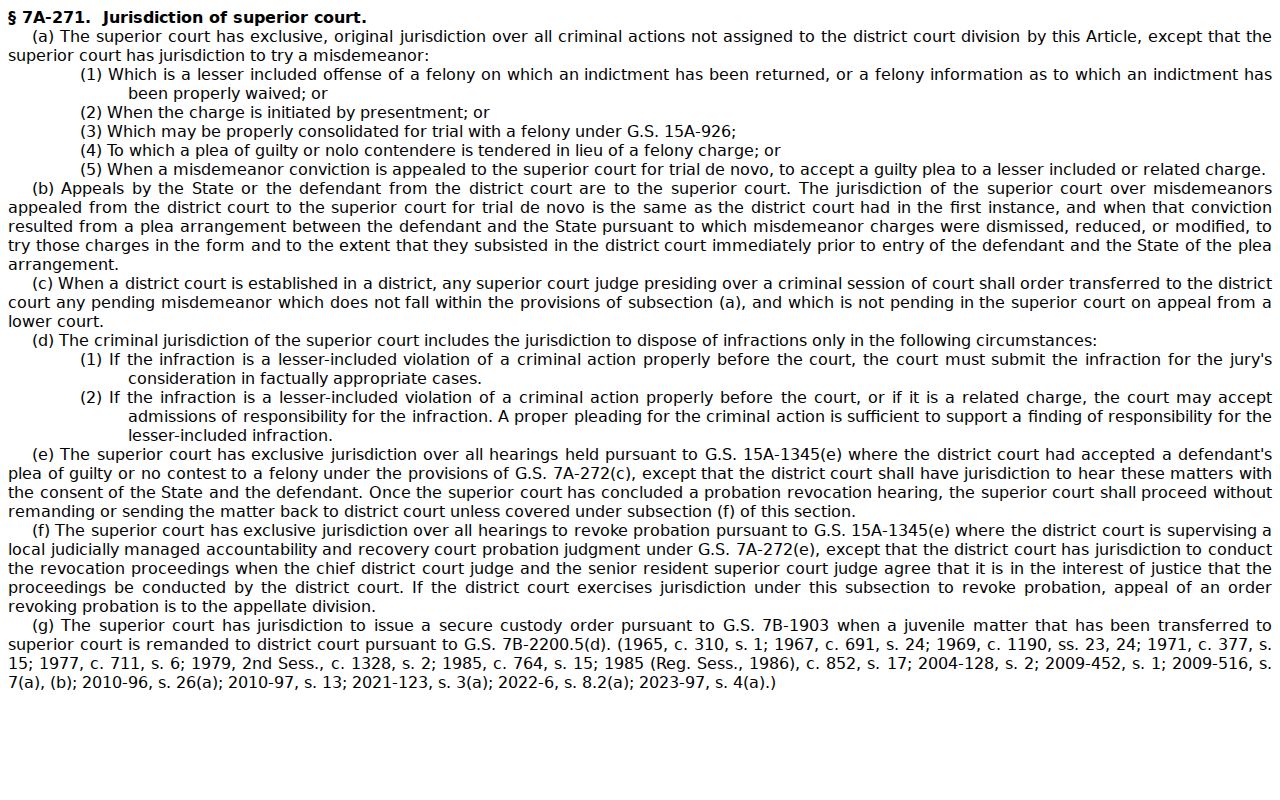
Treat an appeal entry as a procedural step forward. It does not erase the earlier judgment or mean the Guilford case is finished.
Guilford County Criminal Docket Courts
For a Guilford felony or Superior criminal case, start with Portal and the current Guilford criminal session calendar. Then confirm details with the clerk. The Greensboro clerk line is (336) 412-7300. The High Point clerk line is (336) 822-6700. Misdemeanor and infraction records in District Court run through the same county clerk structure. Division matters here, because Guilford keeps working Greensboro and High Point courthouse divisions, so a docket may sit in either. Warrant, first-appearance, and bail questions can also call for a magistrate contact. That may be needed before any full case record exists. The Guilford contact directory lists Greensboro criminal and warrant magistrates at (336) 412-7870. It also lists High Point magistrates at (336) 822-6719. Court staff can point you to the right record or date channel. They cannot give legal advice.
Greensboro Clerk of Superior Court
201 South Eugene Street, Greensboro, NC 27401
(336) 412-7300
High Point Clerk of Superior Court
505 East Green Drive, High Point, NC 27262
(336) 822-6700
Guilford Criminal Clerk Terminal Access
When remote case information comes up short, the public self-service terminal at a Guilford County clerk office is the practical fallback. The Judicial Branch allows criminal terminal searches by defendant name, case number, or victim or witness name. Paper files can be inspected at the clerk office in the county where the case sits. Access restrictions and the record's condition still apply. Bring the case number if you have it. Tell the clerk whether you want case information, a plain copy, or a certified copy. Guilford County publishes no flat certified-copy or plain-copy price. So ask the clerk for the current fee and process before requesting mailing or extensive help.
Access Rules for Criminal Dockets
Guilford County criminal court dockets are public unless a law or court order says otherwise. The Clerk of Superior Court holds the Guilford case file. Portal, the public terminal, and courthouse inspection are layered channels. Each has limits. A remote result can be incomplete. A clerk-certified document comes only from the filing-county clerk.
North Carolina access rules: G.S. 7A-109 requires clerks to keep court records and makes them open to inspection unless access is prohibited. G.S. 7B-3000 withholds juvenile records from public inspection except as the statute or a court order allows. A sealed or expunged adult record is not made public by a Portal search.
Sensitive details can be redacted from an otherwise public record. A missing Portal result does not prove an expunction. The clerk can identify the filing office and form path, though not offer individual legal advice.
Guilford Criminal Treatment Court Records
Guilford County appears in Judicial Branch recovery-court materials for Adult Treatment Court and Mental Health Court. These programs do not create a separate public criminal-record universe. The underlying case still follows the court's normal file, access, and restriction rules. Program eligibility and participation details carry their own limits. The Adult Treatment Court page lists Guilford among its programs.
That statewide description is program context, not a substitute for the actual Guilford case record and current court setting. The Mental Health Court page likewise lists Guilford's program context.
For any individual matter, rely on the case record, the clerk, and court direction. Do not infer eligibility or a result from a program listing.